
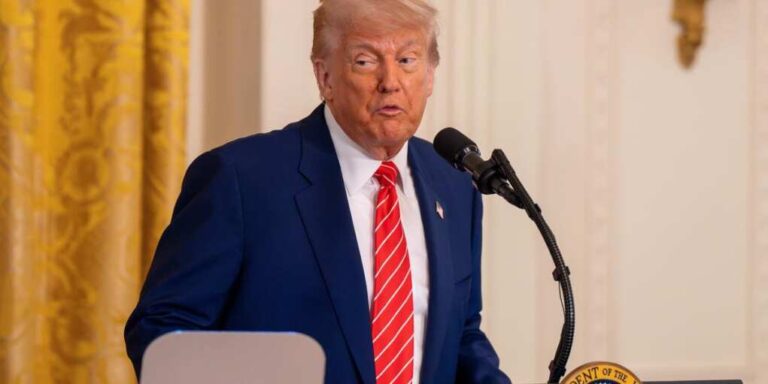
President Donald Trump on Sunday unveiled what he called the “biggest of all” trade deals—this time with the European Union. Speaking alongside European Commission President Ursula von der Leyen at his Turnberry estate in Scotland, Trump detailed a sweeping agreement that shifts the economic landscape between the world’s two largest economies.
Under the new deal, the EU will purchase an unprecedented $750 billion worth of American energy, invest $600 billion more into U.S.-linked ventures, and open up its markets to increased U.S. trade. Trump also confirmed a 15% flat tariff on automobiles and other EU imports, with the tougher 50% steel and aluminum tariffs remaining firmly in place.
“This is the biggest deal ever made,” Trump announced, waving a paper with the agreement’s terms. “It’s going to be great for American jobs, American industry, and American energy.”
Von der Leyen backed him up, describing the deal as “huge” and saying it would bring long-term stability and predictability to businesses on both sides of the Atlantic. “We had some tough negotiations,” she said, “but this brings balance where there was imbalance.” She cited Europe’s previous trade surplus and America’s deficit as core concerns now addressed in the agreement.
The deal arrives just before Trump’s August 1 deadline, when any country without a finalized trade pact with the U.S. would face steep new tariffs. The EU had been staring down a potential 30% penalty on all imports until Sunday’s breakthrough. Trump has used the deadline as a pressure tactic to accelerate new trade arrangements around the globe—successfully, in many cases.
In recent weeks, the Trump administration has secured framework trade deals with the United Kingdom, China, and Indonesia, following the sweeping reforms announced after “Liberation Day” in April. Just last week, Trump revealed that Japan would invest over $500 billion into the U.S. economy in what he called “perhaps the largest Deal ever made.” South Korea, meanwhile, is racing to complete its own trade package ahead of the looming tariff hike.
While specifics of any U.S. concessions in the EU deal weren’t disclosed, Trump has emphasized that these agreements are about putting America in a dominant global trade position. Critics have questioned what may have been traded away behind closed doors, but von der Leyen insisted the agreement benefits both sides by boosting job creation and reinvigorating bilateral commerce.
The announcement is a significant moment not only for the U.S. economy but also for Trump’s global trade doctrine: America holds the leverage, and other nations are lining up to deal. As the world adapts to a new set of economic rules—many written in Washington—the president is driving home a familiar message: American strength creates global stability, and his administration is proving it one deal at a time.